The Biblical Foundations of The Papacy
(Part 2)
Paul Newcombe
THE BIBLICAL FOUNDATIONS OF THE PAPACY
The Symbol of Teaching Authority under the Old Covenant (“Moses Seat”)
The Old Testament Scriptures clearly demonstrate a governing hierarchy of priests who possess authority to rule and regulate the people according to Gods’ covenant statutes. This authority is divinely established and delegated exclusively to the male priesthood for the purpose of maintaining the purity of Gods’ word and to ensure its vitality in the daily faith of the Jews:
“And if any case arises requiring decision between one kind of homicide and another, one kind of legal right and another, or one kind of assault and another, being matters of controversy within your gates, then you shall arise and go up to the place which the Lord your God will choose, and coming to the Levitical priests, and to the judge who is in office in those days, you shall consult them, and they shall declare to you the decision. Then you shall do according to what they declare to you from that place which the Lord will choose; and you shall be careful to do according to all that they direct you; according to the instructions which they give you, and according to the decision which they pronounce to you, you shall do; you shall not turn aside from the verdict which they declare to you, either to the right hand or to the left. The man who acts presumptuously, by not obeying the priest who stands to minister there before the Lord your God, or the judge, that man shall die; so you shall purge the evil from Israel” (Deuteronomy 17:8-12).
In his book Jesus, Peter & The Keys, Scott Butler comments upon this passage:
"In the Old Testament, is there an authoritative human voice to decide matters of doctrine and life? Yes.
Who held this authoritative voice? The Levitical priests, a select group.
What is the process involved in exercising this authority?
(1) This authority is exercised to settle matters of controversy.
(2) There shall be a forum for deciding the proper course of action.
(3) This forum shall show the truth of judgment.
(4) This forum shall decide on death or excommunication for those who do not follow the authoritative voice. This is binding authority". [6]
The Jews, being the recipients of this Mosaic system, continued to implement this kind of binding authority in the days of Jesus:
Then gathered the chief priests and the Pharisees a council, and said, “What are we to do? For this man performs many signs. If we let him go on thus, everyone will believe in him, and the Romans will come and destroy both our holy place and our nation.” But one of them, Caiaphas, who was high priest that year, said to them, “You know nothing at all; you do not understand that it is expedient for you that one man should die for the people, and that the whole nation should not perish.” He did not say this of his own accord, but being high priest that year he prophesied that Jesus should die for the nation, and not for the nation only, but to gather into one the children of God who are scattered abroad. So from that day on they took council on how to put him to death (John 11:47-53).
Butler continues:
"Who is the high priest that headed the council of Pharisees? Caiaphas.
Under what authority does Caiaphas speak? He speaks not for himself, but for God, from his office as the authoritative spokesman for God in the seat of the high priest [Moses seat].
Sinful men of authority, such as Caiaphas, are used by God to teach authoritatively, not because of who they are, [not because of their skill in interpreting the scriptures], but because of THE OFFICE THAT THEY OCCUPY. The symbol of this authority under the Old Covenant is Moses’ seat". [7]
Indeed, Caiaphas is an impious and wicked man who is sinfully plotting the death of Christ; however, in the midst of his scandal he unknowingly utters forth a prophecy regarding the crucifixion of the Messiah. John Chrysostom in his Homilies expresses the unique privileges and dignity attributed to the seat of Moses despite the wickedness of the office-bearer:
“How great is the power of the Holy Ghost? From a wicked mind He brings forth the words of prophecy. And how great is the power attached to the pontifical dignity! For Caiaphas having become high priest, though unworthy of that dignity, prophesies, not knowing indeed what he says. The Holy Ghost makes use of his tongue only, but touches not his sinful heart.” [8]
Butler continues:
"Is the authority of Caiaphas binding on the Sanhedrin? Yes. From the day that Caiaphas spoke prophetically from Moses’ seat the chief priests and Pharisees formed a plot to put Jesus to death.
Where is Moses’ seat found in the Old Testament? It is apparently found nowhere in Scripture, but it is found in oral tradition and in written commentaries. According to Jewish oral tradition Moses received the Torah from God upon Mt. Sinai thus establishing his seat of teaching authority. Moses delivered the Torah to Joshua; and Joshua delivered it to the Elders; and the Elders delivered it to the Prophets; and the Prophets delivered it to the men of the Great Synagogue — the Pharisees. The Jews understood that Gods’ revelation, received by Moses, had been handed down in uninterrupted succession. The scribes and the Pharisees of Jesus day participated in this authoritative tradition and as such their teaching deserved to be respected. However, when the scribes and Pharisees spoke from Moses seat, Jesus judiciously separated their binding dogmatic authority from their lack of personal holiness:
Then spoke Jesus to the multitude, and to his disciples, “The scribes and the Pharisees sit on MOSES’ SEAT; so practice and observe whatever they tell you, but not what they do; for they preach, but do not practice” (Matthew 23:1-3).
To what are Christians morally bound in Matthew 23:1-3? Christians are morally bound to the magisterial seat of Moses …which was assumed by Jesus Christ and passed on to Peter and the Apostles until the end of time." [9]
Remembering that the New Testament explains, fulfills, and builds upon the Old Testament, we can safely expect the New Covenant Church to likewise be preserved in truth by a governing hierarchy of priests. This New Covenant hierarchy must, of course, also rule the Church of God through a divinely established teaching office. This teaching office being necessarily built upon the universal authority possessed by the seat of Moses.
The Structure of the Davidic Monarchy:
A Blueprint of the New Covenant Church
A second line of evidence supportive of the Catholic papacy is found in the Old Testament Kingdom of David. Its system of authority to rule and regulate the people according to Gods’ covenant statutes again demonstrates God’s consistent ways of preserving His truths. God’s expectations are not left up to individual interpretation or even a group of elders. Once again, authority resides in a centralized teaching office which bears a striking uniformity to the authority system still present in the Catholic Church.
James Akin, in his The Papacy: God’s Gift to the Church, outlines the structure of the Davidic Monarchy and the Catholic Church in the following manner:
"The bible describes King David as a man after God’s own heart (1 Sam. 13:14). King David was chosen by God to be the mediator of a new Covenant with Israel — the “Davidic Covenant.” In the establishment of this Covenant God promised that He would build a royal dynasty, a succession of Kings, from the throne of David in Judah. The descending kings in this royal line would ultimately lead to the long-awaited Messiah who would inherit the throne of David and build a kingdom far surpassing the Davidic monarchy.
King David, like all kings, was a very busy man. He had funds to raise, public works projects to oversee, crimes to punish, legal cases to settle, wars with other nations to fight, foreign diplomacy to conduct, and that is on top of the tasks of an ordinary man, such as eating, sleeping, and raising his family. Due to the vast workload, it was impossible for David to personally administer everything in his household, which included more than a thousand family members and servants. There were supplies to be ordered, meals to be cooked, children to be put to bed, students to be taught, wives to be clothed, rooms to be cleaned, servants to acquire and replace, floors to be scrubbed, walls to be panelled, accounts to be balanced, vendors to be paid, and hundreds of other tasks.
Because there was no way David could personally oversee those doing these tasks, no way he could give instructions personally to every servant or family member, no way he could reward them if they followed the instructions or punish them if they didn’t — David appointed a group of ministers to handle the overseeing of his house for him. It was these servants who would instruct, reward, and discipline the members of the household in their daily tasks.
But this house was so large, with so many members to oversee, that there was a large number of ministers overseeing them and whenever you have a large number of people doing something — there are going to be quarrels. Members of one department are going to want things which another department wants for itself. Some will think the children need to be taught one way, while others will think they need to be taught differently. Some want the daily schedule ordered one way; others want it ordered another. And there needs to be some way to settle these quarrels and keep the overseeing ministers operating as a harmonious group.
So, the wise King David arranged for such a method. He appointed one particular minister who would serve as the Chief Steward of his house, rather like the President today has the White House Chief of Staff. This minister, who was accountable to King David alone, had the task of settling quarrels, keeping ministers in line, and in general keeping the house together and running smoothly.
When the King was away, this meant that the chief steward (or chamberlain of the house) was in charge. He was the head of the household when the king was away and was second in command when the king was present.
This arrangement of having one chief minister who could oversee the lesser ministers and keep them from getting into conflicts with each other was so successful that it was used by the later kings of the House of David and even by the kings of the House of Israel when they broke away from the Southern Kingdom after Solomon died.
Now why are those important lessons for us? Because today, for us, there is also a chamberlain for the people of God. When the time came for the Messiah to appear — the one who fulfilled God’s covenant with David, who Himself is the new and perfect David — He did something very similar in setting up His kingdom.
The new kingdom would not be a merely national enterprise, like the old kingdom, but an international one which would include people of many nations. This made it an even bigger organization, which would need an even greater organizational structure. And so, to govern the members of His household, the New David, like the first David, appointed ministers. We call them apostles and bishops and priests and deacons, but that is who they are — Christ’s ministers, who oversee His household.
And as before, whenever you have a host of ministers, there are going to be conflicts that need to be settled, and for that you need a central authority — a chief minister who has charge over the others. If you don’t have a central authority to settle disputes you will have chaos, and the household will disintegrate into multiple competing sects. So, when Jesus, the Son of David, went about setting up His kingdom and appointing its first ministers, He wisely set up a chief minister". [10]
Once again, we see God’s wisdom being manifested through appointed intermediaries like David in the Old Testament. The structure of the house of David reveals a lot about the way in which God fathers His children. Salvation is a family affair experienced in a household of faith. Gods’ kingdom on earth exhibits a family hierarchy where the older and wiser children are called into positions of authority to be spiritual fathers and mothers to the younger siblings. This family hierarchy is, of course, explained and fulfilled by the New Covenant Church — Gods’ family kingdom upon earth:
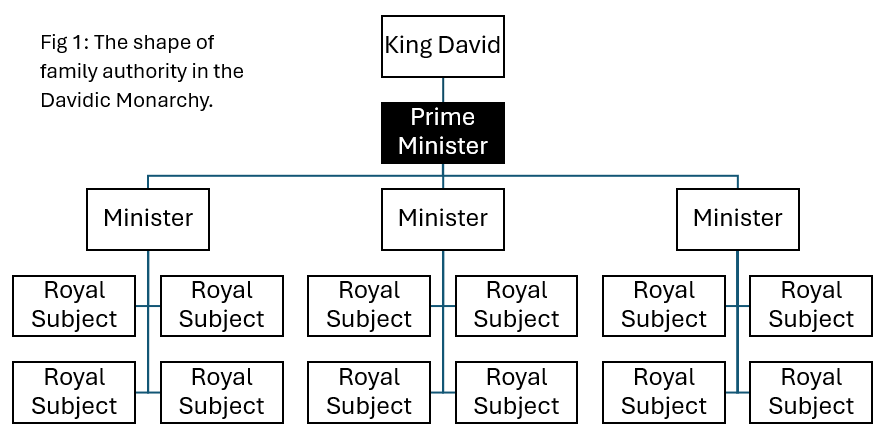
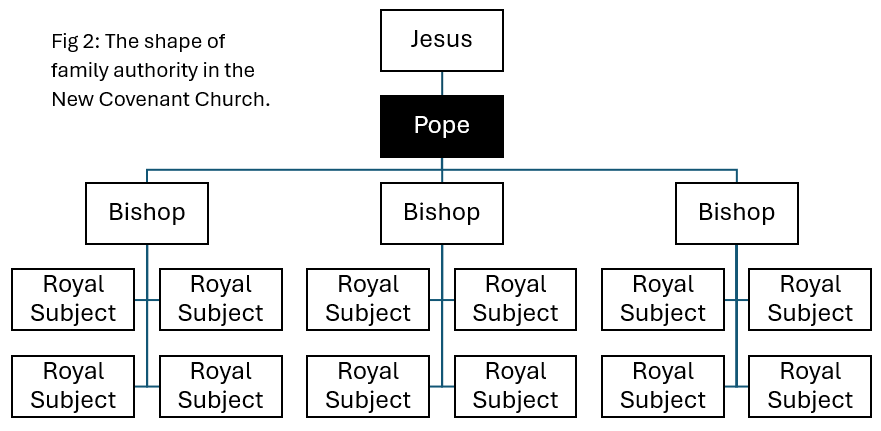
Catholic theologian, Steve Ray, observes the regular biblical references to the prime minister who ruled over the Davidic House during the Old Testament period. He also recognizes how this pattern of centralized authority flows directly into the establishment of the New Covenant Church:
"During the reign of Solomon, we first discover Ahishar, who is 'over the house' in 1 Kings 4:6. Ahishar seems to be the first person recorded in the Bible to be delegated with the keys of David, though he is not necessarily the first royal steward. Next, we find Arza as steward 'over the house' during the reign of King Elah (1 Kings 16:9). The next recorded steward is Obadiah, who was 'over the house' during the reign of King Ahab (1 Kings 18:3). About 150 years later, Isaiah prophesies against Shebna and foretells the appointment of his successor, Eliakim. The Scriptures show us that the office of steward was one of succession—it was always filled. The keys of David were passed from one steward to the next throughout the history of Israel and later also in Judah. Since Jesus restored the throne of David, he also restored the office of royal steward." [6]
Footnotes:
[1] Butler, S., Dahlgren, N., and Hess, D. Jesus, Peter & The Keys, Santa Barbara, Queenship Publishing, 1996, p. 152.
[2] Ibid, p.153-4.
[3] Chrysostom, John. Homilies on the Gospel of John, Homily LXV, 391 A.D.
[4] Butler, S., Dahlgren, N., and Hess, D. Jesus, Peter & The Keys, Santa Barbara, Queenship Publishing, 1996, p. 153-159.
[5] Akin, James. The Papacy: God’s Gift to the Church. 1996. Nazareth Resource Library. http://www.cin.org/users/james/files/papacy.htm, access date: 19 July 2005
[6] Ray, Steve. Upon This Rock, Ignatius Press, San Francisco, 1999, p.291.